
TL;DR
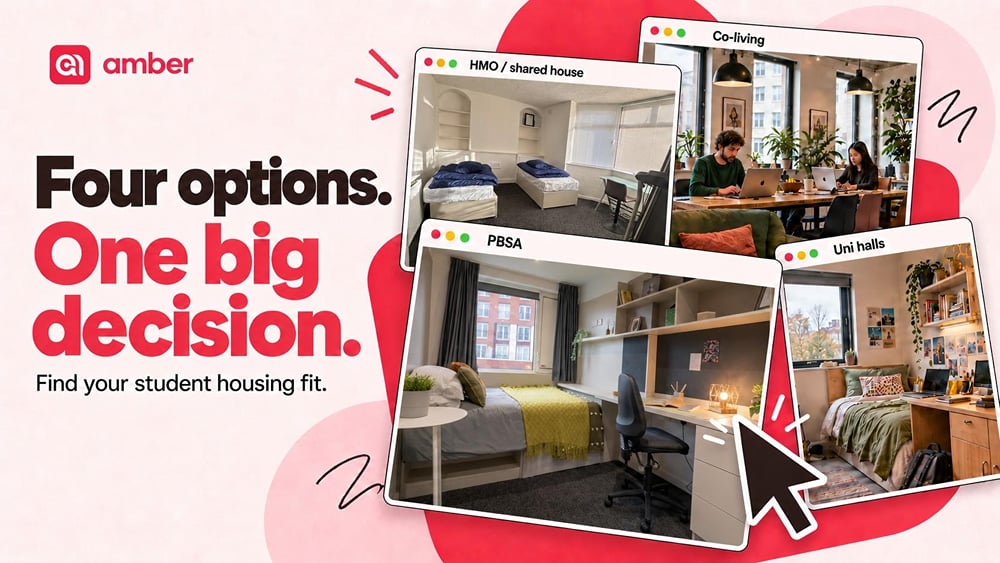
- HMO/shared houses: Often cheaper and more flexible, especially with friends, but you’ll manage bills and deal with a landlord or agent.
- PBSA: Offers predictable costs, student-focused facilities and on-site support.
- Co-living: Combines private space with shared amenities and a built-in social scene.
- University accommodation: Offers structured support and a classic first-year experience, but availability can be limited.
- Don’t compare rent alone: Factor in bills, deposits, transport and contract length.
- Rules vary by country: Check the contract and local regulations before signing.
- By the end of this guide: You’ll be able to compare costs, flexibility, privacy, support and contracts across all four accommodation options and understand which factors matter for your situation.
It’s 11 pm. Four tabs open: a shared house that’s cheap but 40 minutes from campus, a PBSA studio that’s nearly double but “all-inclusive,” a co-living building with a gym and a cinema room, and your uni’s portal asking you to accept an offer by Friday. They all promise a bed, a desk and “an amazing student experience.” They are not the same thing. The four formats exist across the UK, US, Australia and Europe; what changes by country (and often by state or city) is the legal stuff, contracts, deposits, local charges. We flag those differences and cite where each rule comes from.
What do they mean?
Before you compare prices or features, understand what each accommodation type actually offers, and what you’ll be taking on as a tenant.
Some PBSA buildings market themselves as co-living. Some university "halls" are actually PBSA leased by the uni. Features vary building by building; always verify the specific property, not the label.
- HMO (House in Multiple Occupation): the UK's legal term for a private shared house or flat where 3+ unrelated people share a kitchen or bathroom. Everywhere else it's just a privately rented shared house or apartment (a share house in Australia, a WG in Germany). Usually the lowest weekly rent. You deal with a private landlord or letting agent. Best if you've got a friend group and don't mind splitting bills.
- PBSA (Purpose-Built Student Accommodation): private buildings designed for students, cluster flats or studios, typically bills included, on-site management. Best if you want predictable costs, a good ecosystem surrounded by students and everything handled by one team.
- Co-living: a newer format, private studios or rooms in professionally managed buildings open to young professionals as well as students, usually with big shared spaces and organised events. Best for postgrads and students who want privacy plus a built-in social scene.
- University accommodation: Halls, dorms or residences owned by your uni or run by a partner provider. Allocation-based rather than pick-your-room. Best for first-years who want the classic first-year experience and maximum support.
On-campus vs off-campus: where do the four options sit?
Location mainly affects your commute, transport costs, access to campus and the convenience of your day-to-day routine.“On-campus” and “off-campus” cut across the four formats rather than matching them. Uni halls are usually on or next to campus (though some are PBSA leased by the uni and can be a bus ride away); PBSA and co-living cluster in city centres and student districts; shared houses are wherever the cheap streets are. So the real question is not “on or off?” but “how far, at what cost, with what support?”
| Factor | On-campus (uni halls;) | Off-campus (PBSA, co-living, shared house) |
|---|---|---|
| Commute | Walk to lectures; roll out of bed at 8:40 for a 9 am lecture. | Anything from a 10-minute walk to a 40-minute bus. Cost it in: fares plus the willpower tax of an early commute. |
| Cost | Bills and (where catered) meals in the fee; e.g. Manchester ensuite from £7,373 / 41 weeks (Source: University of Manchester 2026/27 halls pricing [6]). Contract ends with the academic year, so you pay for fewer weeks. | Weekly rent can look lower (shared house) or higher (studio), but contracts run longer for instance, 40–51 weeks for PBSA, rolling, or 12 months for private rentals and bills, transport and deposits sit on top. Run the full-stay formula. |
| Contract & rules | Licence agreement, not a tenancy: the uni’s own terms on notice, guests and noise apply (Source: Unipol: Renters’ Rights Act). | Local tenancy law applies to private rentals (rolling in England (Source: Unipol: Renters’ Rights Act; fixed with break fees in NSW (Source: NSW Government: Breaking a lease early); open-ended in Germany (Source: BGB §573c); PBSA and co-living use their own fixed contracts. |
| Support | Residential life teams, wardens or RAs, wellbeing services a corridor away. | PBSA and co-living: on-site teams and 24/7 cover in many buildings. Shared house: you and your landlord. |
Availability matters as much as preference: most universities guarantee first-years a place in halls only if they apply by a deadline, and returning students usually move off-campus by default, which is why the off-campus options above exist at the scale they do.
What will you actually pay?
University halls publish their prices, so they make a clean benchmark. Private options move with the market, so compare live listings for your city rather than trusting a number in a blog.
| Country | University halls (official 2026/27 rates) | Private options (PBSA, co-living, shared house) |
|---|---|---|
| UK( Manchester) | £139–£237/week equivalent for a 41-week contract, depending on room type. Ashburne Hall ranges from £5,697 for a small single room with a washbasin to £9,710 for a single en-suite.(Source:Ashburne Hall 2026/27 Payment Plans, 41 Week Accommodation Agreement. | Quoted per week, typically on 44–51-week contracts; bills usually bundled in PBSA, separate in shared houses. For example - £145/week to £368/week (source: amber listing in Manchester) |
| US (Boston) | Boston University: standard double/triple room $13,170 plus a $7,570 dining plan ($20,740 for the academic year); single room in an apartment $21,140 with no dining plan required. (Source: Boston University housing rates 2026–27 ) | Quoted per month on 12-month leases as standard; utilities often separate. $950/per month to $4100/per month (source: amber listing in Boston) |
| Australia ( Sydney) | UNSW University Terraces: twin room from A$341 per person per week, regular studio A$452, one-bedroom A$551 Wi-Fi, electricity, gas and water included, 51-week contract. (Source: UNSW University Terraces 2026 rates ) | Quoted per week; bond of up to four weeks’ rent held by NSW Fair Trading. AU$160/per week to AU$1450/per week (source: amber listing in Sydney) |
| Germany ( Munich) | Studierendenwerk halls: most single rooms in shared flats €330–480 a month, single apartments €360–550, utilities included; waiting lists of one to six semesters. (Source: Studierendenwerk München rent list, June 2026) | Quoted per month, usually as cold rent plus utilities; deposit up to three months’ cold rent. €1399 to €1427/per month ( Source: amber listing in Munich) |
Rent is quoted per week in the UK and Australia and per month in the US, and most of Europe convert before you compare.
What “bills included” actually covers
Bundles commonly cover utilities, Wi-Fi and contents insurance. Check for: fair-use energy caps (exceed them and you pay the difference), whether laundry is free or card-operated, whether “gym” means a gym or two treadmills, and whether catered halls cover weekends. In a shared house, assume bills are separate unless the contract says otherwise, and add a realistic monthly utilities figure for your city on top of rent before you compare.
Country-specific extras that are in nobody’s bundle:
| Country | Extra | What it costs |
|---|---|---|
| UK | TV Licence | £180 a year; needed for live TV or BBC iPlayer, including in your own room in halls. No student discount; refund for unused summer months. |
| Germany | Rundfunkbeitrag (broadcast fee) | €18.36 a month per dwelling; one person registers per WG. Exempt if you receive BAföG (or equivalent home-country grant) and don’t live with parents. ( Source: Rundfunkbeitrag.de) |
| US | Renters’ insurance and utility set-up | Often a lease requirement rather than an inclusion; rules vary by state, check your state’s tenant guide. |
Advance cost that you need to pay
Your move-in budget needs to cover more than rent; check the deposit and any rent you need to pay upfront.
| Market | Deposit / bond | Rent in advance |
|---|---|---|
| England | Capped at five weeks’ rent where annual rent is under £50,000; must be protected in a government-approved scheme. | Landlords can no longer demand more than one month’s rent in advance once the tenancy is signed (since 1 May 2026) ( Not applicable to PBSA). ( Source GOV.UK: Tenant Fees Act. For exceptions, you can check Unipol: Renters’ Rights Act |
| Australia | Maximum four weeks’ rent, held by NSW Fair Trading (Rental Bonds Online), not the landlord. | There is a statutory cap. According to the NSW Government, a landlord or agent can request a tenant pays rent up to 2 weeks in advance, but no more, and cannot ask for further rent payments until all paid rent has been used . Tenants’ Union NSW: Bond |
| Germany | Maximum three months’ basic (cold) rent, payable in three monthly instalments. | No statutory cap on advance rent; ask. ( Source BGB §551) |
| France | One month’s rent unfurnished; two months furnished (excluding charges). | If rent is paid quarterly in advance, no deposit may be charged. ( source: Service-public.fr: unfurnished deposit ) |
| US | Set by state: one month’s rent in New York and Massachusetts, up to three in Nevada, no statutory limit in Texas, Florida and others. | Varies by state; first and last month up front is common where allowed. ( Source: Nolo: US deposit limits by state ) |
Council tax and local charges
In the UK, a household where everyone is a full-time student pays no council tax; add a non-student and the property gets a bill, possibly with a discount (Source: GOV.UK: Council Tax for students).
Uni halls of residence are generally exempt from Council Tax, but the position can be different in private accommodation. In a mixed shared house, the non-student occupants are generally responsible for the bill, while full-time students are disregarded for Council Tax purposes. You may also need to provide your university certificate to claim your student exemption.
Co-living houses can include non-students too, so students living there still need to claim the exemption using a certificate from their university.
— Abhishek Bajaj ( Director at amber - Supply Partnerships)
Most other countries don’t tax tenants this way, but check local equivalents: city registration and the broadcast fee in Germany (Source: Rundfunkbeitrag.de), and insurance or utility set-up requirements in US leases.
The full-stay calculation (do this before anything else)
A lower weekly rent doesn’t always mean lower overall costs. Here’s how the numbers can add up.
Contracts and what happens if your plans change?
This is the section that varies most by country. In England, it changed dramatically on 1 May 2026, so if you’re reading older advice: bin it. Treat the table as a map, not legal advice.
| Market | Private shared house / HMO | PBSA | Uni halls |
|---|---|---|---|
| England | From 1 May 2026, most private assured tenancies are rolling rather than fixed-term. Students can generally leave with two months' written notice, timed to their rent period. Eligible student HMO landlords may use Ground 4A to regain possession between 1 June and 30 September, subject to conditions and notice requirements. | PBSA covered by an approved student accommodation code is exempt from the assured periodic tenancy system. Fixed academic-year agreements can continue, and students are usually responsible for rent throughout the agreed term unless an early-release provision applies. | Usually governed by a fixed-term common-law tenancy or licence, with cancellation and early-departure conditions set out in the agreement. |
| Australia (NSW) | Fixed-term agreements are common. For applicable residential tenancies of up to three years, early termination fees range from four weeks' rent when less than 25% of the term has passed to one week's rent after 75%. Exceptions apply. | Contract terms depend on the provider and whether the arrangement falls under NSW residential tenancy law or another accommodation arrangement. Check the cancellation provisions. | Cancellation and departure conditions depend on the university's residence agreement and applicable law. |
| Germany | Residential tenancies are often open-ended, with a standard tenant notice period of approximately three months. Deposits are generally capped at three months' cold rent. | Contract length and termination rights depend on the tenancy arrangement. Student residences can have different legal provisions from ordinary residential rentals, so check the agreement. | Typically governed by the relevant Studierendenwerk or university residence agreement, including its termination provisions. |
| US | Twelve-month leases are common, but terms vary by state and property. Shared leases may include joint and several liability, making tenants responsible for rent owed by housemates. | Fixed-term student housing contracts are common. Early termination, replacement-tenant and cancellation provisions vary by operator and applicable state law. | Terms are governed by the university housing agreement, including withdrawal and cancellation policies. |
After reading the above table, you must be thinking of an odd outcome, at least in England: the “risky” shared house is now legally the easiest option to leave, and the “safe” PBSA contract is the most binding.
Daily life ( privacy, housemates, and getting things fixed )
The contract is only part of the decision; consider how privacy, housemates, social life and maintenance will affect everyday living.
| Details | HMO / shared house | PBSA | Co-living | Uni halls |
|---|---|---|---|---|
| Privacy | Own room, shared bathroom | Ensuite cluster room or studio | Usually a private studio | Standard, ensuite or catered; corridors shared |
| Housemates | You choose them; stakes are friendship-shaped | Allocated cluster; count the humans (a 5-person kitchen ≠ a 10-person one) | Mixed students and professionals | Allocated, the lottery can hand you best mates or a 3am pasta enthusiast |
| Social life | Whatever you make it | Organised events in many buildings | Organised community events (quality varies by operator) | Residential life programmes |
| Maintenance | Report to landlord or agent; speed depends on them ask outgoing tenants | On-site team, defined response times, out-of-hours cover | On-site team, defined response times | On-site team, defined response times |
Ask any building: what’s your noise policy, guest policy, and what actually happens when someone breaks them?
Which option fits your situation?
There’s no one-size-fits-all choice: your budget, year of study, privacy needs, group size and flexibility can point you towards different options.
| Your situation | Usually best | Why |
|---|---|---|
| Tight budget | Shared house with friends | Wins on raw cost if you do the full-stay maths and split bills like adults; a basic uni room can beat it once transport and bills are counted. |
| First-year or international, arriving alone | Uni halls or PBSA | Allocation puts people around you, support teams exist, individual contracts protect you from strangers’ rent problems. |
| Friends who want to live together | PBSA cluster (group booking) or shared house | PBSA: individual contracts, no bills admin. Shared house: cheaper, more freedom, joint liability, choose wisely. |
| Privacy first | Studio | PBSA for an all-student building; co-living for a mixed, quieter crowd and better common spaces. |
| Postgrad, placement, uncertain dates | Co-living or a rolling shared-house tenancy (where local law allows) | Most flexibility to leave; check PBSA summer/short-stay options if you need an all-student environment. |
Inside amber's Booking Data: What Gets Booked and Where?
We analysed 30,000+ bookings made through amber between September 2025 and September 2026 across 14 countries to understand which accommodation types are booked through our platform.
One important distinction: these figures reflect amber's available inventory, not the preferences of all students. For example, nearly 100% of amber's UK bookings are for PBSA, largely because PBSA makes up most of the platform's UK inventory. That doesn't mean nearly every student in the UK prefers PBSA.
The data shows booking patterns within amber's marketplace, including differences between destinations and contract lengths.
1. Which Accommodation Types Get Booked on amber?
Not sure where to start? PBSA is the most commonly booked option on amber, but your budget, privacy needs and level of support should guide your choice.
2.How Do amber Bookings Differ by Destination?
Heading to a different country? According to the amber’s booking data the accommodation options students choose can look very different by destination, so check what’s commonly available before deciding.
Source: Amber booking Data
3. How Long Are Students Booking For?
Your ideal accommodation also depends on how long you need it, especially if your course or plans don’t follow a full academic year. Below is an infographic based on the amber booking data that gives you an idea of what students usually prefer.
Source: Amber booking Data
Note: The data excludes university-owned halls, and amber’s listing categories don’t map perfectly to standard accommodation types: “student accommodation” refers to PBSA, “independent house” covers shared houses or HMOs, and “branded independent house” represents co-living or managed housing.
There's no universally “best” option out of HMO, PBSA, co-living and uni halls, only the one that fits your budget, your year, and how much you're willing to take on. A shared house wins on raw cost if you've got a friend group and don't mind splitting bills; PBSA and uni halls win on predictability and support, especially for first-years and international students arriving alone; co-living sits in between, built for postgrads and students who want privacy without giving up a social scene.
Whichever way you lean, run the full-stay calculation before you commit, read the contract terms for your country rather than assuming last year's rules still apply, and check what a specific building actually includes rather than trusting the label. From there, comparing live listings side by side, on amber or elsewhere, is the fastest way to turn “which one's right for me” into an actual booking.
Methodology
- University halls pricing was sourced from official 2026/27 rate pages: University of Manchester 2026/27 halls pricing, Boston University housing rates 2026–27, UNSW University Terraces 2026 rates, and Studierendenwerk München rent list, June 2026.
- Private-market weekly/monthly rates for PBSA, co-living and shared housing were sourced from live listings on amber's platform: amber listing, Manchester, amber listing, Boston, amber listing, Sydney, and amber listing, Munich.
- England's notice periods, deposit caps and advance-rent limits were sourced from Unipol: Renters' Rights Act and GOV.UK: Tenant Fees Act 2019 statutory guidance.
- Australia's (NSW) break-fee and bond rules were sourced from the NSW Government: breaking a lease early and the Tenants' Union NSW: bond factsheet.
- Germany's deposit cap and tenant notice period were sourced from the German Civil Code, BGB §551 and BGB §573c.
- France's advance-rent and deposit rule was sourced from Service-public.fr: unfurnished deposit.
- US security deposit limits by state were sourced from Nolo: security deposit limits by state.
- PBSA's exemption from the assured-tenancy system in England was checked against the ANUK/Unipol National Code.
- The UK council tax exemption for all-student households was sourced from GOV.UK: Council Tax for students.
- Germany's broadcast fee (Rundfunkbeitrag) and the student exemption were sourced from Rundfunkbeitrag.de.
- All prices, contract terms and legal thresholds were checked as of 15 September 2026. Country notes cover England, New South Wales, Germany, France and selected US states only. Scotland, Wales, Northern Ireland, other Australian states and other EU countries have their own rules, so check locally.
- We revisit this guide periodically to keep pricing, regulatory detail, and listing examples current.