
TL;DR
- Accommodation costs: Budget around £145–£300+ per week, depending on room type and location.
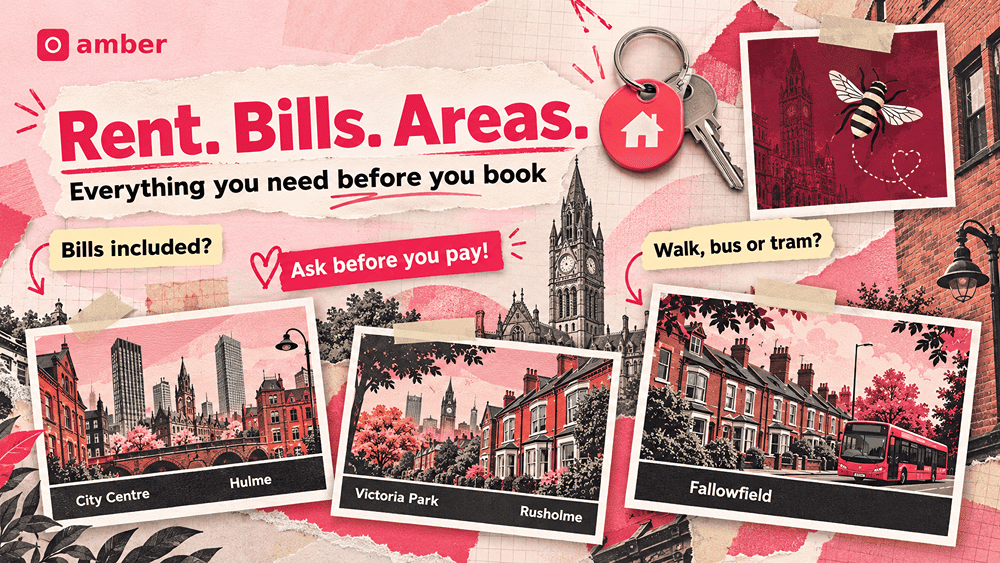
- Where to live: Compare City Centre, Fallowfield, Victoria Park, Rusholme, and Hulme based on your budget, campus, and lifestyle.
- Commute smartly: Nearby areas can offer public transport journeys of around 5–30 minutes, depending on your university and route.
- Weekly budget: Plan for approximately £300 per week for rent and everyday expenses.
- When to book: Start researching early. August recorded the highest booking activity from 2024 to 2026.
- Save on essentials: Check student discounts through TOTUM, UNiDAYS, and eligible Bee Network travel passes.
- Useful apps: Try Bee Network, Citymapper, Trainline, and Co-op Living for transport, journeys, and everyday savings.
- Student insights: Explore local food spots, social hubs, and practical tips from Manchester students before choosing where to live.
Manchester has pretty much everything a student could want: big universities, busy streets, plenty of places to eat and drink, and student life that doesn’t really switch off. But there’s one decision that can make a surprisingly big difference to how you experience the city: where you live. A room that looks like a great deal on paper might mean a long commute to campus, while paying a little more could put you closer to university, friends, shops, and the places you’ll actually spend your time. So, finding student accommodation in Manchester isn’t just about picking a room you like. It’s about finding a location that fits your budget, university, and lifestyle without making everyday life harder than it needs to be. This guide breaks down the areas, costs, commutes, and practical details you’ll want to know before you book. We also interviewed a student residing in Salford and studying at the University of Salford to get real-time insights on his journey in Manchester.
The Manchester Areas Students Should Know
Manchester has pretty much everything a student could want, but where you choose to live can shape how easily you access it. From getting to campus and meeting friends to finding places to eat, shop, and unwind, different parts of the city offer a different day-to-day experience. Manchester’s student accommodation is spread across a few distinct areas, each offering its own balance of campus access, social life, and convenience. To see where students are actually choosing to live, we analysed amber’s Manchester booking data from 2024 to 2026 and grouped properties by postcode district to identify the areas with the highest booking activity and the most-booked properties in each area. The descriptions and nearby places below then give you a feel for what each neighbourhood offers.
| Area | What it’s like | Why students consider it | Most booked properties |
|---|---|---|---|
| City Centre | Right in the middle of Manchester, with places like Manchester Arndale, Northern Quarter, Federal Café Bar, and Canal Street close by, alongside restaurants, shops, and major transport links. | Useful if you want city life on your doorstep and easy access to the university campus. | Manchester Student Village and iQ Lambert & Fairfield House |
| Fallowfield | A student-heavy suburb centred around Wilmslow Road, with places like HAUS, The Studio Bar, and The Friendship Inn, plus shops and takeaways. | Popular with students who want a strong social scene while still having regular bus connections to campus and the city centre. | Weston Court and Allen Court |
| Victoria Park | A quieter, greener area close to Whitworth Park and Platt Fields Park, with Rusholme's restaurants and shops along Wilmslow Road nearby. | Works well if you want a shorter commute without being right in the middle of the city-centre buzz. | Q3 Apartments, The Grafton, and iQ Wilmslow Park |
| Rusholme | Built with more than 70 restaurants and food businesses along Wilmslow Road, including Mughli Charcoal Pit, Lal Qila Express, and MyLahore. | Convenient for students who want quick access to campus, food, and everyday essentials. | MSV South |
| Hulme | A central neighbourhood just south of Manchester city centre, with Hulme Park, Hulme High Street, local shops, cafés, and student accommodation nearby. It is also close to both the University of Manchester and Manchester Metropolitan University. | Useful for students who want easy access to the city centre and university campuses while staying in an area with a strong student community and plenty of everyday amenities. | Canvas Manchester and Manchester House |
Our student interviewee who is living in Salford and studying at the University of Salford said he chose the accommodation near his uni campus to ease the commute:
For me, because my course is at MediaCity, I explored accommodation around that area. There was another accommodation as well, I think it starts with 'IQ', so those were my options.
— Shashwat Nishant, University of Salford (2026-2027), Masters in Sports Journalism, Interviewed on 30 September 2026
Manchester Student Accommodation Rent: What’s the Ballpark?
Based on the accommodation listings analysed on amber’s Manchester page, weekly rents vary considerably by room type, location, and amenities. Lower-priced rooms can start from around £145 per week, while studios and apartments can cost more than £300 per week. Rather than relying on a single city-wide figure, students should compare the rent range for their preferred room type and area when setting their accommodation budget.
What Does Your Manchester Student Budget Actually Get You?
Once you know your overall budget, the next question is what kind of accommodation you can actually get for it. From shared-bathroom rooms and en-suites to studios and apartments, here’s how Manchester’s main room types compare in terms of space, setup, and weekly rent.
| Room type | Description | Average weekly rent listed on amber’s Manchester page | Example |
|---|---|---|---|
| Non-ensuite (standard / shared bathroom) | A private bedroom with access to a shared bathroom and shared living spaces. | From £145 per week to £314 per week | iQ Kerria Apartments |
| Ensuite | A private bedroom with its own attached bathroom and shared communal spaces. | From £145 per week to £325 per week | Vita Student Circle Square |
| Studio | A self-contained space combining a bedroom, living area, kitchen, and private bathroom. | From £180 per week to £360 per week | Yugo Element Manchester |
| 1-bed apartment | A private apartment with a separate bedroom, living area, kitchen, and bathroom. | From £180 per week to £305 per week | iQ Fletcher House |
| 2-bed apartment | An apartment with two private bedrooms and shared living, kitchen, and bathroom spaces. | From £145 per week to £305 per week | iQ Fletcher House |
| 3-bed apartment | An apartment with three private bedrooms and shared living, kitchen, and bathroom spaces. | From £186 per week to £229 per week | Canvas Manchester |
Rent Isn’t the Whole Bill
The weekly rent is only one part of your accommodation costs. Before signing a contract, check what’s included in your rent, particularly utilities and internet, as inclusions can vary by property. You should also check how much you’ll need to pay upfront, whether a deposit is required, and if you’ll need a guarantor. It’s also worth knowing your rights as a student tenant in the UK and what landlords can ask of you before you commit.
Where You Study Should Shape Where You Live
Where you live affects more than just your rent; it can shape your daily commute, travel costs, and how easily you get around Manchester. Starting at your university can help you narrow down areas that keep travel manageable without pushing your budget too far. Once you’ve found an area that works, student discounts and travel passes can help bring down some of your everyday costs.
Here’s how to make your location and student status work a little harder for your budget.
From Campus to Accommodation: How Long Is the Commute?
With so many universities across Manchester, where you live can make a big difference to your daily routine. Use your university location as the starting point, then look at nearby areas that balance affordability and convenience. This table gives you a quick way to compare nearby areas and approximate public transport commute times before narrowing down your accommodation search.
| Institution | Nearby affordable area | Approximate commute time by public transport | Nearest Property |
|---|---|---|---|
| The University of Manchester | Rusholme (from Manchester Royal Infirmary (Stop E)) & Victoria Park (from Upper Brook St / Booth St East) | 5-10 min | Kincardine Court |
| Manchester Metropolitan University | Hulme (from Royal Northern College of Music (Stop B)) | 10-15 min | Yugo Element Manchester |
| University of Salford | Salford (from Salford Crescent Rail Station (Stop A)) / Ordsall (from Cross Lane) | 5-20 min | John Lester and Eddie Colman Courts |
| The University of Law – Manchester | Ardwick (from Piccadilly (Stop EP)) / Hulme (from Piccadilly Gardens) | 15-20 min | Iconinc Manchester Victoria |
| Arden University | Hulme (from Oxford Street (Stop SV)) / Salford (from Bridge St) | 10-30 min | Bridgewater Heights |
| BPP University – Manchester | Hulme (from Oxford Road Station) / Ardwick (from Piccadilly (Stop EP)) | 15-25 min | Vita Student Circle Square |
Our interviewee who studies at the University of Salford says:
Manchester is pretty well connected. The trams and buses really sort your commute out. For me, I mainly commute when I want to explore or visit places like Indian grocery stores because my campus is so close that I can walk there. My accommodation is just a 10 minute walk away from MediaCity campus
— Shashwat Nishant, University of Salford (2026-2027), Masters in Sports Journalism, Interviewed on 30 September 2026
Student Discounts in Manchester
Students in Manchester can cut down on everyday costs by using discounts on food, shopping, travel, and entertainment. A TOTUM student discount card offers deals across hundreds of brands, while UNiDAYS provides free student discounts from participating retailers and food brands. For travel, students can also use the Bee Network to access discounted fares, including the 18–21 travelcards where eligible. Before buying anything, it’s worth checking whether a student rate is available, as discounts and eligibility can vary by brand and product.
Before You Book: Timing and the Numbers You Need to Know
So, when should you actually start looking for Manchester accommodation? To get a clearer picture, we looked at amber’s Manchester accommodation booking data from January 2024 to September 2026 and tracked how enquiry activity changed month by month. The pattern was pretty clear: things start picking up around March, build through spring and summer, and hit their highest point in August across all three years.
When Does Manchester Accommodation Start Running Out?
If you’re planning to study in Manchester, when you book can be just as important as where you book. Amber’s booking data from 2024 to 2026 shows a consistent pattern: bookings are relatively low in January and February, begin picking up from March, grow steadily through May and June, and rise sharply in July before peaking in August.
That doesn’t mean you need to book your room as soon as January arrives. Instead, the quieter start to the year can be a good time to start researching areas, comparing properties and narrowing down your options. By spring and early summer, you can start making your booking while demand is still building.
Come July and August, competition for accommodation increases, with August recording the highest booking activity in each of the three years analysed. If you’re after a particular area, room type or property, leaving your search until late summer could mean having fewer options to choose from.
The takeaway? Start looking early, compare your options through spring, and try not to leave your Manchester accommodation search until the last minute.
What students can do acc to the months
Jan–Feb
Start researching Manchester areas, universities, and accommodation options.
Mar–Apr
Shortlist properties and compare room types, prices, and locations.
May–Jun
A good window to make your booking before demand picks up further.
Jul
Bookings start climbing, so popular options may see more competition.
Aug
Peak booking activity across 2024–2026; waiting this long may mean fewer choices.
The earlier you book, the more options you have. I guess the prices are also lower because the demand isn't that high at that point.
— Shashwat Nishant, University of Salford (2026-2027), Masters in Sports Journalism, Interviewed on 30 September 2026
What Does a Typical Student Week Cost?
Rent might be your biggest expense, but it’s far from the only thing that leaves your bank account. A typical student budget also has to cover groceries, transport, takeaways, going out, your phone, clothes, and the occasional unexpected expense. The exact amount depends heavily on your lifestyle, but estimates point towards approximately £300/week, which means £1200/month.
Expenses
(Weekly estimates are calculated from Numbeo's latest Manchester price data (September 2026), where monthly or individual prices are available. Categories such as groceries and socialising are indicative student-budget estimates rather than direct Numbeo weekly figures.)
Source: Cost of Living in Manchester | Numbeo 2026
Our student interviewee quoted his weekly cost as:
In a week, if we take into account bus commutes and groceries, probably around £20–£25 if you're only cooking at home. That works for me, without including rent.
— Shashwat Nishant, University of Salford (2026-2027), Masters in Sports Journalism, Interviewed on 30 September 2026
Manchester After Lectures: Where Students Actually Spend Their Time
Lectures might finish, but Manchester’s not done for the day. Students can head out for food, coffee, shopping, live music, nightlife, or just a spot to chill with friends. The city centre has plenty going on, while Fallowfield and Rusholme are packed with student favourites. Where you live can make getting to these places either a quick walk or a whole commute.
Where Students Eat, Shop, and Hang Out
Manchester’s student life extends well beyond university campuses, with different neighbourhoods offering their own mix of food, cafés, shopping, and places to meet friends. Fallowfield is one of the most student-focused areas, particularly around Wilmslow Road. Recent student discussions mention Fuel Cafe Bar and Cuppa Chaii as popular café options for studying, grabbing coffee, or meeting friends. Rusholme, meanwhile, is known for the food along Wilmslow Road. Students and Manchester locals regularly mention places such as Mughli Charcoal Pit, Bardez, MyLahore and My Peshawar, alongside smaller Middle Eastern, Afghan and South Asian restaurants.
For Victoria Park, the nearby Rusholme and Wilmslow Road areas provide much of the food and everyday shopping, while gardens offer somewhere to take a break from university life. Students also mention Whitworth Park as a nearby spot around the university area. In the city centre, the choices expand considerably, with the Northern Quarter, Chinatown and Canal Street offering restaurants, cafés, bars, independent shops and nightlife. Shashwat Nishant, a student ambassador, also says Old Trafford is a good pick for someone who’s into sports; it’s the home of Manchester United. He mentioned Etihad Stadium as a popular spot for sports lovers as well.
I've been to Don Tacos in Piccadilly Gardens. It's a Mexican food chain. The other place was Las Iguanas. They had a bottomless brunch there, which was pretty nice, and they also had a student discount.
— Shashwat Nishant, University of Salford (2026-2027), Masters in Sports Journalism, Interviewed on 30 September 2026
The Apps Manchester Students Actually Use
Moving to Manchester comes with plenty of small things to figure out, from getting around the city to finding cheaper ways to eat, travel, and manage your everyday plans. Having a few useful apps ready before you arrive can make those first few weeks much easier. From public transport and journey planning to food deals and train tickets, these are some apps worth having on your phone, recommended by our student interviewee who says these apps have helped him with exploring and commuting.
Two apps that have helped me are Citymapper and the Bee Network app. They've helped me with exploring and commuting. They tell you which stop to walk to, what time the bus will arrive, and what your options are if you miss the bus. These two apps have helped me a lot. Also, my accommodation has a Co-op right next to it. I enrolled as a member because of the discounts, so the Co-op app also helps.
— Shashwat Nishant, University of Salford (2026-2027), Masters in Sports Journalism, Interviewed on 30 September 2026
Bee Network
Bee Network is the official app for planning journeys across Greater Manchester. You can use it to check bus, tram, and train routes, plan journeys, and buy eligible tickets, making it useful for getting to university and exploring the city.
Citymapper
Citymapper can help you compare different ways of getting around Manchester, including walking, buses, trams and trains. Citymapper is also mentioned in Manchester Reddit discussions as an option for checking routes and live transport information, particularly when navigating unfamiliar journeys. Our interviewee regularly uses Citymapper to get groceries and other short trips.
In terms of getting groceries and exploring a little of the city, I don't think there are any blockers. I've downloaded the Citymapper app, and it really sorts you out.
— Shashwat Nishant, University of Salford (2026-2027), Masters in Sports Journalism, Interviewed on 30 September 2026
Trainline
Trainline lets you search and book train journeys across Manchester and the wider UK. Before booking, it can be worth comparing fares with the relevant train operator or official rail-ticketing options, as prices and fees can vary. It can be useful for students planning trips outside the city, although Manchester residents on Reddit note that it's worth comparing prices with National Rail or train operators directly before booking.
Co-op App
Co-op helps students and shoppers manage their Co-op membership, find nearby stores, and access member discounts. It can be useful for students living close to a Co-op, especially when picking up everyday groceries and looking for ways to save on regular purchases.
Our Final Take
Manchester gives students plenty of choice, but the right accommodation comes down to what works for your university, budget, commute, and lifestyle. From the city-centre buzz to the student communities of Fallowfield, Rusholme, Victoria Park, and Hulme, each area offers something different. With booking activity building towards late summer, starting your search in spring or early summer can also give you more choice before demand picks up. The best place to live isn’t necessarily the busiest or cheapest; it’s the one that makes your everyday student life easier. Our interviewee told us that his biggest surprise when he came to Manchester was something he never expected:
The biggest surprise for me was the ease with which I adjusted to the city. I was expecting more confusion and times when I would feel lost or something, but that wasn't really the case for me. I'd say that was the biggest surprise for me. People are helpful and kind. Whenever you're confused about something, they try to help you sort it out. So, it's been a good experience so far.
— Shashwat Nishant, University of Salford (2026-2027), Masters in Sports Journalism, Interviewed on 30 September 2026
Methodology
We combined Amber’s Manchester accommodation listings, booking and enquiry data, a student ambassador interview, and third-party sources to help students compare accommodation, neighbourhoods, commuting, everyday costs and student life.
- Amber’s accommodation data: We used Amber’s Manchester accommodation listings to compare weekly rent ranges, room types and example properties. We analysed Amber’s Manchester booking data from 2024–2026, grouping properties by postcode district to identify popular student areas and the most-booked properties within each area. These findings reflect bookings through Amber rather than the entire Manchester accommodation market.
- Amber’s seasonal demand analysis: We compared monthly enquiry activity from January 2024 to September 2026 to identify seasonal demand patterns and inform advice on when to start searching. Booking and enquiry figures came from Amber’s internal records.
- Student ambassador interview: Amber’s content team interviewed Shashwat Nishant, an MA Sports Journalism student at the University of Salford’s MediaCity campus. Through a question-and-answer interview, we gathered first-hand accounts of his accommodation search, booking timing, living arrangements, spending, commuting, local recommendations and app use. We reviewed the interview transcript and selected relevant experiences and quotations with his permission. His comments reflect his personal experience as a student who had recently moved to Manchester.
- Everyday living costs: Amber does not produce its own dataset covering Manchester’s everyday living expenses, so we used external sources to support student budgeting. Numbeo’s Manchester cost-of-living data informed the original budget as a useful crowdsourced price reference, alongside indicative student-budget estimates. The revised breakdown uses the University of Manchester’s 2026/27 undergraduate living-cost estimates, with annual amounts divided by 41 weeks and rounded. The weekly total covers only the eight categories shown, rather than every possible student expense.
- Locations and commuting: We used Google Maps to check university locations, nearby areas, public transport stops and approximate commute times. Journey times vary by starting point, route, departure time and service conditions.
- Student discounts and travel: We used information from TOTUM, UNiDAYS, TfGM’s “Travelling to university” page and the Bee Network’s 18–21 ticket eligibility and terms to inform the discount and travel sections.
- Student recommendations and community experiences: Amber does not maintain its own dataset of student-rated cafés, restaurants or social spots. We therefore used Reddit as a useful source of first-hand community recommendations alongside Shashwat’s interview. We treated these posts as personal opinions rather than verified or representative findings. Discussions included “Any library/cafe suggestions to study in Fallowfield?”, “Curry mile recommendations” and “Whats manchester like as a student”.
- Student apps: Recommendations drew on TfGM’s university travel guidance, Shashwat’s experiences, and the Reddit discussions “New in Manchester” and “Any tips about Manchester public transport for foreigners?”. Official pages for Citymapper, Trainline and the Co-op Membership app provided supporting information about journey planning, train bookings and membership savings.
Disclaimer: Information about tenancy agreements, deposits, guarantors and tenant rights is for general guidance only and does not constitute legal advice. Requirements vary by accommodation provider and tenancy type, and laws may change. Before signing or paying, review your agreement and seek advice from your university’s housing team, Citizens Advice or a qualified legal adviser if anything is unclear